

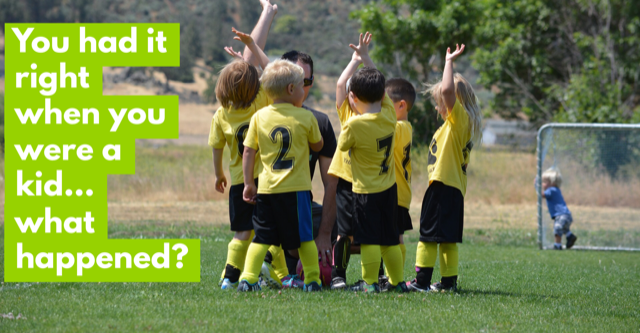
17 Jan You Had It Right When You Were a Kid… What Happened?
There are many types of personality assessments available these days, but did you know that most stem from a handful of psychiatrists? Carl Jung seems to be one of the foremost accurate and noted analysts of modern time along with Katherine C. Briggs and her daughter Isabel Briggs-Myers who developed the MBTI. Another modern type of assessment that you may be familiar with is the DiSC personality profile, but did you know that a form of personality temperament theory dates back as far as Hippocrates’ time around 400BC.
I won’t bore you with the history lesson, but I will add one more type of assessment that has gained attention, True Colors. A version of Temperament Theory that may be more relative in a story.
My fitness center happens to be upstairs overlooking a gymnasium at a local multi-sport center where I live. As I began my 30-minute read-and-ride routine (a New Year’s resolution btw), I couldn’t help but notice the boisterous group of kids that came bursting onto the gym floor. There were about fifty of them, all grade three students, along with a small group of teachers and what I would guess from previous experience, a group of volunteer parents.
I tend to pay closer attention to kids’ behaviors now that my children are in their teens and twenties. Kids, for the most part, have a freedom of expression long forgotten by adults. They have no political views, little stress, no work issues and certainly not the bombardment and judgement of social media. They have unbridled imagination. Kids play and express themselves in their purest form.
I watched as the teachers randomly divided the kids into 6 teams. Once the teams were assembled, two teams were sent to each of one of three stations where a sport awaited. Soccer in one, dodge-ball in another and tag in a third. At first glance, a passer by would simply see a large group of kids having fun playing games, but to someone with familiarity in Temperament Theory, you would see something completely different. The kids, by default, were falling into specific and natural roles. Coincidental or not, the roles weren’t only reflective of Temperament Theory, but they were also very similar to what Hippocrates identified over 2000 years ago as the four categories that people naturally seemed to fit.
There was the boy who sat on the sidelines, reading a book, waiting his turn, but not overly interested in the game at hand. His clothes, blandly bleeding into the background, his hair tussled as if he had made a halfhearted attempt to comb it before leaving the house.
There was the cheerleader. Hair in a pony tail, with a few perfectly added curls, a bright colored shirt and contrasting jeans. She jumped up and down screaming as the ball bounced haphazardly from one kid to the next, until being corralled by a boy dressed in sweat pants and a sports jersey.
The sporty looking boy, in his brand name runners and his orange TMNT head band(it’s a turtle thing), zoomed around the other kids and swiftly kicked the ball past everyone into the goal. He then celebrated by running around the gym shouting and waving his finger in the air. The other kids ran toward him and cheered while the poor goalie rescued the ball from the net and angrily tossed it out to his team mates.
On the sidelines, a smartly dressed boy in a tightly checkered, button-up, long sleeved shirt, also waved his finger in the air. He was not cheering however, instead, he was trying to catch the eye of the teacher, shouting out how the goal doesn’t count because the boy had stepped out of bounds, and according to the rules, you can’t score from out of bounds.
As the boy stated his case with emotion, a red-haired girl, with a short bob pulled back in a blue ribbon, rubbed him on the back telling him not to worry as it was only a game. Her head tilted to the side as she spoke, she seemed to have a genuine concern for the boy’s reaction.
When the whistle blew, the teams moved on to the next station and the next event, and low-and-behold, the same pattern began to emerge. Sure, the demographics were different; kids had different clothes, hairstyles and skin color, but the temperaments were similar. A couple of kids on the sideline distracted by something other than the game. Kids who stood out among the rest in either athleticism or attitude ran amuck. Kids who knew the rules and boundaries, and kids who were there to console and make sure everyone was involved.
Now look around your workplace, your home, or even your favorite tv shows. Do you see similar characters emerging? Do you see the eager and impulsive performer? The analytical investigator? The organized loyalist? The compassionate enthusiast? They are all there in various degrees, some more brilliant than others, but they are all there. These are the True Colors; Orange, Green, Gold, and Blue… and when you align a persons True Colors with tasks… well, that’s where the magic happens.
You had these natural temperaments when you were a kid, and if you followed your natural path, you’ve probably found yourself happy and successful in your current profession. If you aren’t happy, then maybe somewhere along your path you ended up in a role for the wrong reason and you have been battling your natural disposition. Find out what your natural path is with Temperament Theory and get into your groove.
Are you looking for a course that’s a proven winner that will entertain and provide immediate payoff? Is your curiosity peaked? Perhaps you are just looking for a way to bring out the best in people. If you or your organization would like to learn more about True Colors and whether Temperament Theory can improve productivity and reduce conflict in your workplace, contact rumble@smilingrhino.ca.

No Comments